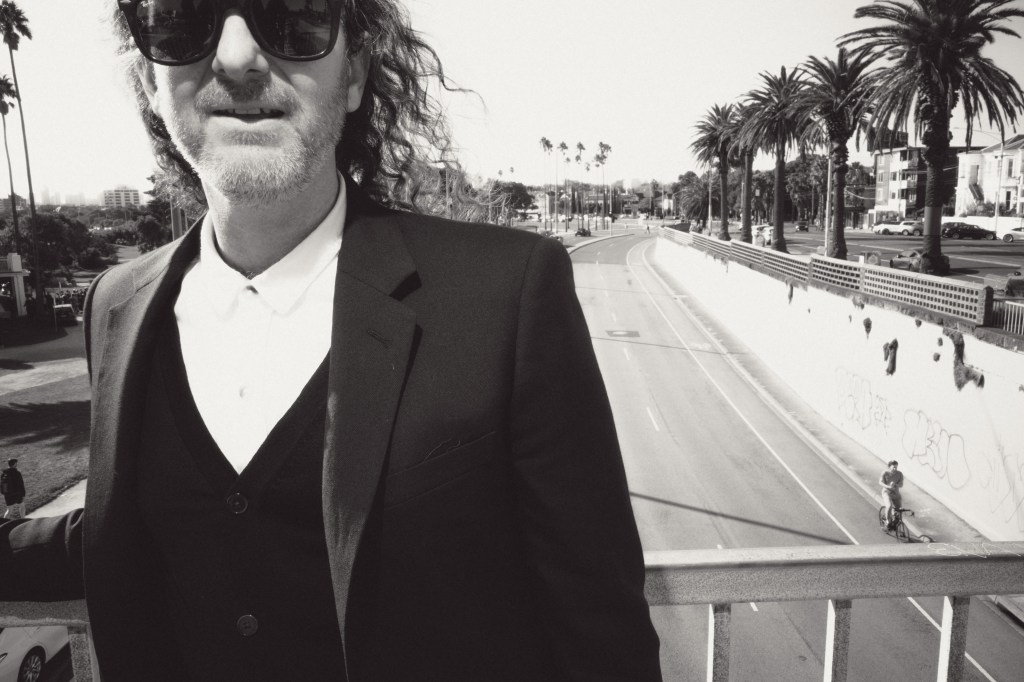
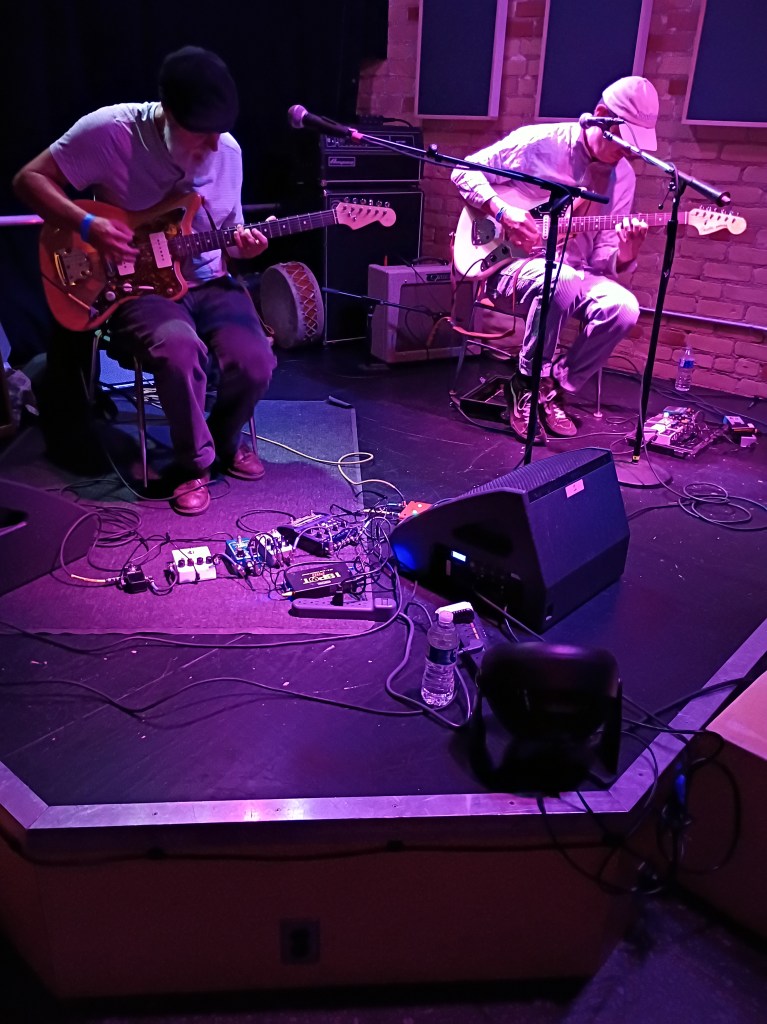
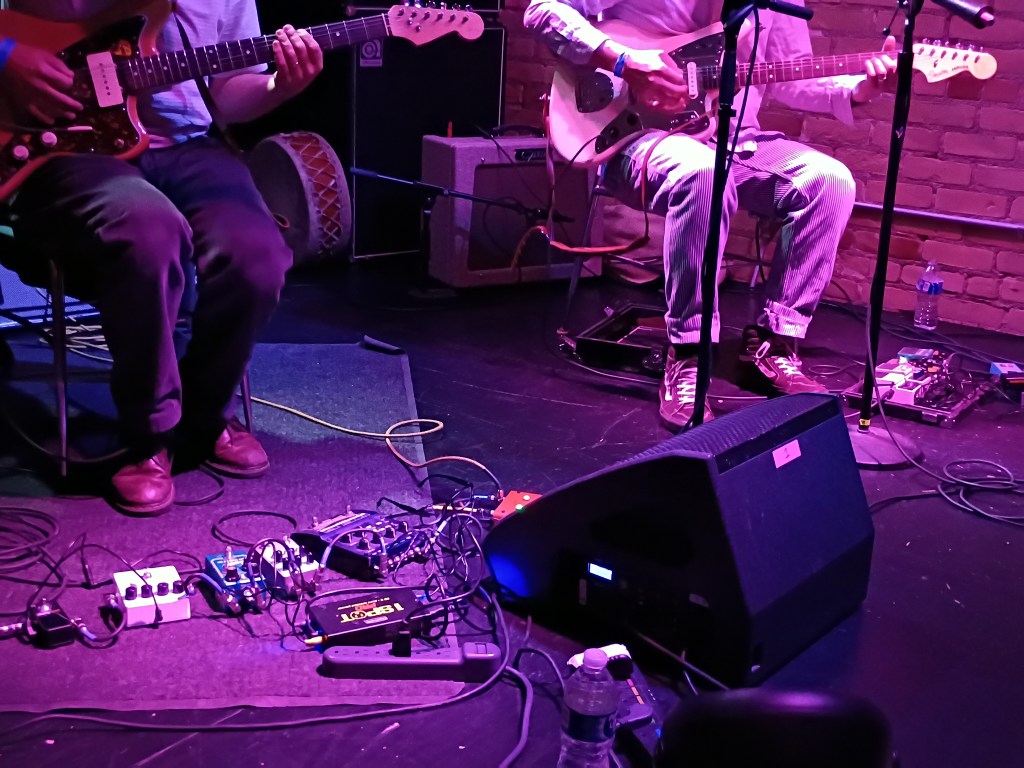
• (photo credit: Jamie Wdzeikonski)

    #1: Hey Mike! Know you just got back from a US tour – making this the 3rd continent you’ve toured this year, correct? How have tours been going for you? What makes for a good tour? Is it a different experience in different continents? Are you seeing a unique appreciation as an artist throughout particular parts of the world?

    M: Hey Ian, Yeah, we’ve hit North America, Australia, and Europe this year – it’s been a busy one. I’ve felt pretty lucky – each of the tours has felt like a dream run. It’s been a blast playing with Nick and Monika and folks have responded well. It feels like there’s a bit of progress or momentum, so that keeps things exciting. Things that make a good tour: good crowds, good food, good weather, comfortable accom (we were very lucky to stay with some very generous folks this last year). Less glamorous, but vitally important are folks buying tickets, records, and merch – the money side of things is totally make or break on a tour, and we’ve been really fortunate there as well this year. On top of that, bigger festivals anchor a tour, so festivals like Binic Folks Blues in France and Gonerfest in Memphis really made things possible this year.

    #2: So I’d like to go way back to the beginning. I know you’re originally a California guy – can you talk about what your life was like there? When and in what capacity did you start making music? Do I remember right in hearing you did sound at The Hemlock Tavern in SF for quite awhile?

    M: I was born in Merced, California, in the Central Valley. We were fairly close to Yosemite National Park. My childhood was a pretty average middle class suburban semi-rural one. I didn’t really fit into that sliver of American society. I picked up a guitar for the first time in college in Santa Barbara, but it wasn’t until I moved to Melbourne that I really started digging in, playing in a first band, going to shows, being exposed to something other than MTV and mainstream radio. After a year in Melbourne studying, I moved to LA and started working in studios and writing music for the first time. I was in Melbourne for a year, then LA for three, then back to Melbourne for five years. After visa struggles, I was back in San Francisco in 2010, and that’s when I started working at the Hemlock. That was a real transformative experience – I was probably seeing 10 bands a week, and Hemlock was an epicenter for independent local and touring musicians in SF. Anthony Bedard, who was the booker for the Hemlock, is now my booking agent (Talent Moat), so that was a very influential time.

    #3: So was your initial move to Australia for college, then? What was it you studied? How did the culture feel different than in CA? Was the move to Los Angeles calculated? Was leaving CA once again for Melbourne calculated as well? What drew you to Australia?

    M: Yeah, my initial move to Australia was for an exchange in 2002 – my last year of college. I studied world religions. I had been brought up in a relatively conservative area by relatively conservative parents. Melbourne’s culture for me at that time was very much the opposite – I loved the absence of taboo and the city’s thriving arts and music scenes. Moving to LA after that year was really just a stab in the dark. I had returned from Melbourne enamored with the place and the people, and didn’t really feel like I had a place to return to. I moved to LA because there was a recording school there and I knew I wanted to make music. Leaving LA a few years later for Melbourne was totally calculated – I spent a lot of time researching visas, and trying to find a way to get back over there. I never really fell into a scene I liked in LA – I look back somewhat fondly of my youth spent in studios, but really that part of my life seems disconnected to the musical path I found myself on once I was back in Australia.

    #4: Okay, so now you’re back in Melbourne for 5 years. Are you playing in bands at this point? And/or solo? What’s the musical atmosphere looking like in 2005 – 2010? Are you feeling any different treatment, being from the States? What are you doing to make ends meet on a visa?

    M: When I moved back to Melbourne in 2005, I started playing music with friends straight away – this was a particularly formative period for me, slowly figuring out how to be in a band, book shows, and put out releases in a DIY manner. There were always a few songs that I wrote that didn’t really fit the bands that I was playing in, but I didn’t really start playing on my own until 2008. The musical atmosphere in Melbourne at that time was incredible. Slowly, the music scene was moving to the north side of the river, but there were still some interesting things happening in St. Kilda. It felt like I caught the very end of that scene, and was lucky enough to see Rowland S. Howard play a handful of times. Bands like the Stabs, The Drones, Dirty Three all loomed pretty large at the time for me in Melbourne. I also got to see The Saints, Laughing Clowns, Beasts Of Bourbon, Scientists, etc. It was a pretty special time. I was a bit of a novelty being from the states, but I did my best to adapt myself and not stick out too much. I started teaching music at this time – it was one of the things I could do with the visa I had.

    #5: I’m incredibly jealous you got to see Rowland play. The Birthday Party are a top 5 for me without a doubt. Tattoo to prove it.Were there any options at all for you to stay in Australia? How are you feeling about leaving at this point? What made you move to San Francisco this time?

    M: Unfortunately the visa I was on was only a temporary one, so I missed out on extending it. Australia makes it extremely difficult for people to gain residency outside of student and limited work visas. When I had to go back to the states, I wanted to try someplace different – LA was never the right fit for me, and at the time, SF and Oakland had a great music scene. My family is in Northern CA, so that was a factor as well.

    #6: So now it’s 2010 and you’re in the Bay Area working at the Hemlock. Are you making music upon being back in the States? Do you have to form a whole new band, or are you kicking it solo at this point? Where are we here in the lineage of your recorded output? How are you liking SF?

    M: I tried my best to hit the ground running as soon as I moved to SF, but it took a while to get things going. I did some recording with my friend Ray Raposa up in Portland (A Horse 7″), went on a couple solo tours, and tried to play as much as possible. I was keen to get a band together at that point, but things take time in a new city. I played a show with Utrillo Kushner (Colossal Yes) in 2011, and we really hit it off. I asked him to play drums on an upcoming recording (Mountains + Valleys EP), and things kinda grew from there. Utrillo is a person who is universally loved, and had done a lot of touring in the past, so once I knew him, my universe kinda opened up as far as a Bay Area and US underground music scene is concerned. He’s played on every record I’ve made since, and I really feel like I owe a huge part of my career as an artist to him.SF was pretty cool when I moved there in 2010. Hemlock had a really consistent stream of great shows happening, and bands like Sic Alps, Oh Sees, Ty Segall, Kelley Stoltz, Grass Widow, and tons more were playing a lot. Looking back I probably caught the very tail end of that scene. By 2012 the city felt somewhat overrun by tech frat dudes, a lot of bands broke up or moved to LA, and Oakland was the much more interesting of the two places, so I moved over there.

    #7: Golden Theft, your 2nd album, comes out around this period of time as well, yes? Are you feeling a sense of.. a “fan base”, of a musical community? Do you have a hope of or a plan to return to Melbourne throughout this? How did that return end up happening?

    M: Yeah, Golden Theft was a continuation of ‘Mountains + Valleys’ – I recorded a few more songs with Utrillo and made it into an LP. I don’t think I had much of a fan base at that point outside of folks I knew or had played music with. I was so new to making records, that I didn’t really have a sense of how to do it in a way to get noticed. But Aquarius Records in SF was really supportive (they were the ones who told me it’s better to make your own label to put on a record, so Golden Theft was the first record on my label Spectacular Commodity). That record was the first to start to get noticed in underground circles. My musical community was growing as well. Utrillo had opened up a world of rad musical connections for me in the Bay Area, and my continued touring Australia meant that I was still meeting lots of band, radio, and press folks over there. As much as I loved living in SF and Oakland, I knew that Melbourne was a place I wanted to be – something about the early epiphanies I had had, and close friends I had made. After an Australian/New Zealand tour in 2013, I started dating a new partner I had met there. We dated long distance for while I was living in the states, then I moved back over to be with her.
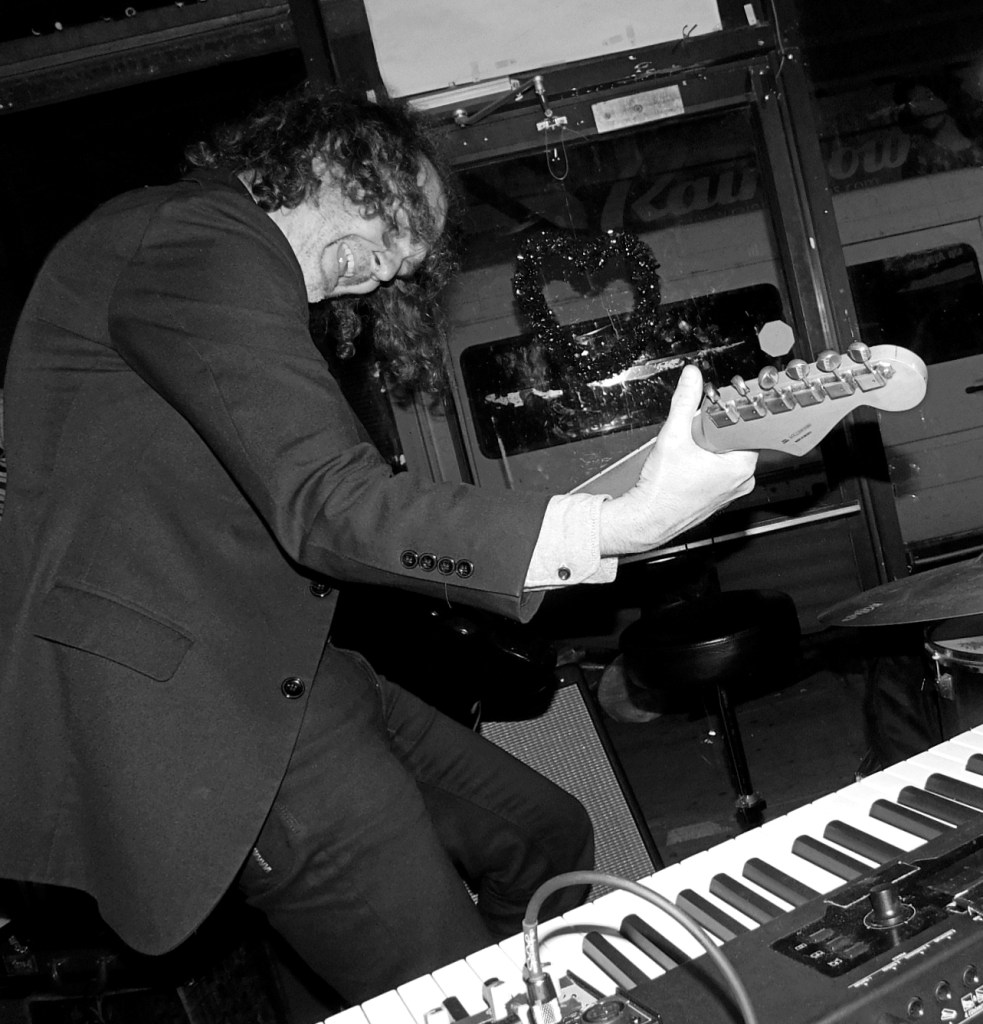
    (photo credit: Dave Brushback)

    #8: So now you’re back in Melbourne. Is this the final move? How do you feel about moving so much? So next up is the 3rd LP, Gravity/Repulsion, which you originally released yourself. Was this recorded exclusively in Melbourne? Are you playing with a regular band or consistent musicians? Are you touring? Are you feeling settled back in Australia, working, feeling part of a community?

    M: Gravity/Repulsion was recorded the week I left Oakland, it was both a culmination of all the work I had put in with Utrillo and Muslim Delgado as a band, and a sort of rushed going away. It was a shorter LP, but those were the songs we had at the time. If I had stayed in the Bay, I probably could have had someone there put the record out, but my plans were made and I was leaving. I was really proud to make that record with Muslim and Utrillo and Phil Manley. I can remember trying to shop it around to a few labels, but because I had just relocated, I was again up in the air with a home base. I played a few shows in 2016 as I started putting together a new band in Melb, but things went slowly as I got settled. My friend Lachlan Denton was particularly helpful/generous in getting things rolling with the band playing drums – he was a fan from when I had toured while living overseas, and he also recruited his brother Zac Denton to play bass in the early days. Sometime in 2016 I made the call to self-release the record – I was keen to get the ball rolling with shows and tours, and didn’t want to wait around. The release of the record was instrumental in helping me form the Melbourne community that I have today. My friend Tom Lyngcoln, The Old Bar, RRR, PBS, and Poison City Records all took a real interest in the record, and slowly spread the word around town without me noticing. Out of nowhere, people in Melbourne seemed to care. I’m still extremely flattered and blown away that that happened. I get the feeling that Tom Lyngcoln has done that for a ton of bands – he’s a real music scene powerhouse, having fronted and championed countless underground Australian bands.

    #9: So is this the last major move for you, then? Have you been able to establish permanent visa status in Australia, either by this point in time or in the current? Can you speak a bit to what that process looks like? Has being an artist been helpful in any way towards securing citizenship?

    M: For the time being it is. I can’t say what the future holds, but for now I’m pretty settled in Melbourne. I became an Australian citizen a few years ago (in addition to my US citizenship), so I can come and go as I please. That process can be quite different (and much more difficult) depending on the person, but in my case the real challenge was getting permanent residence – the step before citizenship. PR is a sizeable barrier to cross in Australian immigration – at that stage you are given ongoing rights to work, healthcare, social services, and eventually a path to citizenship. So most temporary visas don’t make the step from temporary to permanent residence easy. In my case, it was my 5th different visa (each of 1-2 years) before I could meet enough requirements (time/money/evidence/tests) to make that jump. In Australia, artists are at the bottom of the priority list for immigration – I would have had a better chance doing manual labour – so no, it didn’t help. In the end, it was only through my partner’s citizenship that I was able to immigrate.

    #10: Looks like we’ve made it through the past, so let’s keep the questions current and future minded.How’s daily life in Australia? How are shows there for you? Are you seeing a difference in.. crowds, interest, appreciation, what have you between different countries/continents? Do you have favorites? Do you have least favorites? Are there forthcoming tours planned? Where do you go next?

    M: Daily life in Australia is pretty good right now. I’m almost done with a year of touring (have a few shows around Australia with Tropical Fuck Storm for the next two weeks), so I’m finally getting a chance to settle a bit. More time to play music, try to grow some veggies, read, enjoy the summer. Really looking forward to the downtime. Shows have been really great this year, we’ve got to play with some great bands in Melbourne this year – The Hard Quartet, Lost Animal, Simon Joyner, Leah Senior, etc. Our album launch sold out, and the city has really come out to support us, which feels great. Outside of Melbourne, shows in Australia are probably comparable to shows in cities in the US or Europe. Some places/nights we have really great turnouts, and here and there you have an off night. It’s hard to pick a favourite, but this years shows at Hitness Club in Leipzig, Binic Folks Blues in France, Dabadaba in Donostia, Gonerfest in Memphis, Soft Junk in Nashville, The Earl in Atlanta, Union Pool in Brooklyn, and Kilowatt in SF, The Tote in Melbourne were ones – fantastic crowds, great sound, great vibe, so we could really get into a zone on stage. There are unconfirmed festival offers floating around for both the US and Europe next year, so hopefully we can book tours around them. My guess is I’ll be in the US in August next year, but it’s a little bit of wait and see. I’d love to finally make it back to Minneapolis!

    #11: I’ll be 47 that month, somehow: come play here and I’ll book it myself.You’re a somewhat similar age, yea? What keeps you kicking around the underground after a couple decades? Do you anticipate ever being able to live solely off art? Can you picture it being done on your own terms? I’ve seen you’ve pulled your music off Spotify – will you discuss the impetus behind this?

    M: Sounds good – I’ll try my best! Yeah, I was born in ’81, so we’re pretty similar ages. If the nature of your question is why do I keep making music at 20 years, I’d say I still love doing it. As far as why my music remains underground probably has something to do with the type of music I make and the circles I run in. As much as I’d love housing security or extra time to do things at a slower pace (two of the things I imagine financial ‘success’ would bring), I wouldn’t or couldn’t change the way I’m doing things if I tried. So in that sense, my music will hopefully always be on my terms – I’m pretty stubborn in that regard. I can’t really foresee a realistic way that my music is my sole source of income, but I’ve set things up so hopefully it can be a good part of it. The private teaching practice that I run allows me to engage with music for work, and to pass on what’s helped me do what I do, so that feels like pretty decent fortune.I pulled my music off Spotify and Amazon this week. I was happy to disengage from those services. I’d refer anyone who’s curious to find out more about what’s going on to have a look at Deerhoof’s Instagram posts on the matter (or related news coverage) – it’s pretty in depth. Basically, those two platforms were engaging in practices I found pretty revolting, and I didn’t want to be even a miniscule part of their benefiting financially. I pass no judgement on anyone else’s choices in that regard, but it felt right for me. For anyone needing the convenience, there are plenty of other services that do similar things, and ones like Bandcamp let you support artists and labels directly. Maybe one day there will be less focus on convenience in finding music, and more on the benefits of putting in a little bit of work to find something new.

    #12: You mentioned private teaching – will you elaborate on this? What is it you teach? Is there a specific clientele? Have you ever had musical teachers yourself? And then: what’s on the horizon for you? Can we discuss the release we’re chatting on? Are there other releases you’re planning towards?

    M: I’ve taught piano, guitar, and singing for the last 20 years. I find I work best with folks who are self disciplined, so that mostly means adults, but I’ve got some great younger students as well. I took private lessons as an adult, and had two teachers that made a big impression on me, both in my ability to begin to develop my own musical style, and eventually to teach, which I’m very grateful for. Doing so has allowed me to have the flexibility and income to tour and make records, and that hands-on experience is really where I learned how to do everything I’m doing now. I’m currently working on a grant to help fund an upcoming record that Greg Cartwright and I are working on. We wrote a couple songs together when I was in Memphis a few months back and had a great time. We got Natalie and Keith from Optic Sink and JB from Aquarian Blood to help us flesh things out, and the demos sounded really interesting. So I’m hoping to go back and do that this year. I’m also getting a solo set together for a run of shows with Tropical Fuck Storm starting this week, and then need to do some more arrangement for a collab performance with Lloyd Swanton, Mick Turner, and Joe Talia in January. Then in December I’m gonna rest!Super stoked about the possibility of this live record with 25 Diamonds! So stoked you asked, I’ve never released any live performances before. Later this month, I’m gonna listen back to a bunch of recordings from our tours. At this point, I’m thinking one side will be a band thing, and the other might be an excerpt from that January show in Sydney I mentioned before. The last record had two sides to it – kinda a rock band thing, and a more expansive improv sounding thing, so it would be nice to have bits of both. I guess we’ll just wait and see!

    #13: I’m not sure how I want to wrap this up. So I have 2 thoughts:

    1, my friend Fred and I had a conversation a few days ago where we talked about the state of making art in 2025, and more specifically about a feeling that young people don’t seem to connect to music in the way we did when we were young – that there isn’t the community involvement, the obsession with and pursuit of favorite bands – that music is consumed in 20 second sound bites from Tik Tok videos rather than digging through record stores. Are you feeling any of this? Do you have any inklings towards what the future of artist support and independent music looks like? Do you see positives or negatives towards this?

    2, are there topics we haven’t discussed that you would like to? In essence, I’d like you to ask and answer a question yourself.Thanks Mike! You know I’m a big fan, both musically and personally – I’m excited for what your future holds.

    M: For sure, a new generation is going to experience art and music differently than our generation did, especially at the rate things are evolving. Probably different from my preferences for consuming art (I definitely like the community/live band thing too), but I can’t say if it’s better or worse. I’m sure the way I listen to music is already much different now than before we had some much internet around. I’ve got no idea about the future (artist support or otherwise). Art is going to keep happening, and it’s certainly going to look different than it has before. On that topic, maybe it’s good to end by shining some light on a book that I’ve loved recently, that in its own way discusses the nature of art (and the emergence of the poetic image as essential to the human experience) – The Poetics of Space by Gaston Bauchelard. Published in the early sixties, it was a huge influence on modern philosophers like Deleuze and Foucault as well as the fields of art, design, architecture, and many others. At times quite heady, but usually pretty absorbable, it’s a true wonder. My friends Ben Chasny and Pete Warden were both banging on about it around the same time, and it made an indelible impression on me. I can’t recommend it enough. Great to chat, and hope to see ya over there soon!

    Thanks,

    Mike
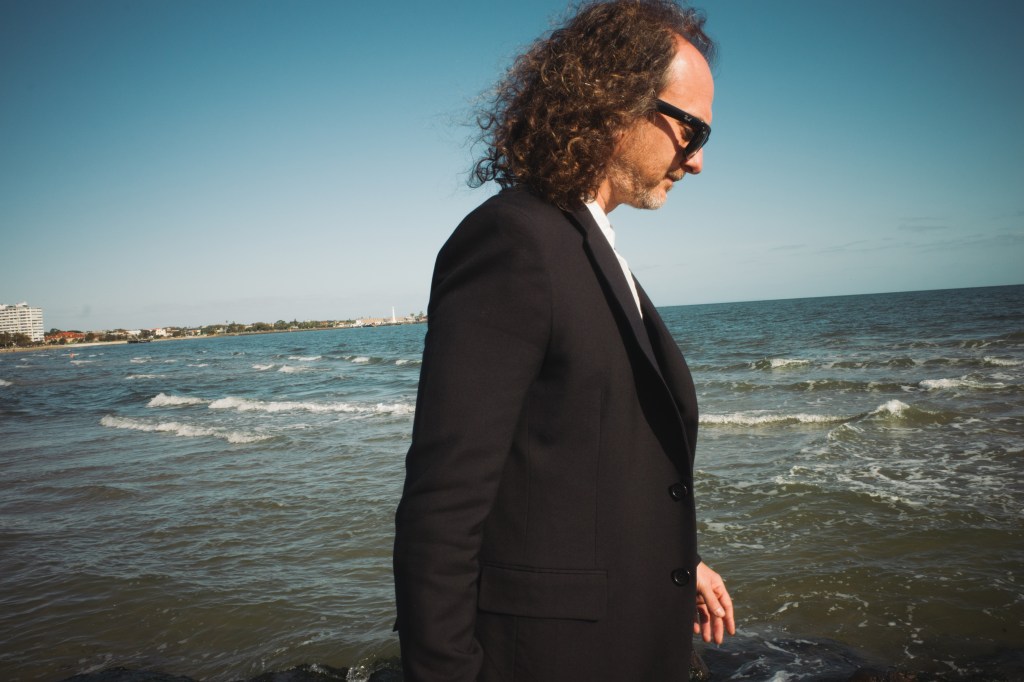
    (photo credit: Jamie Wdzeikonski)
  • (interviewee and interviewer in Ann Arbor, MI, 07/2019)

    #1. Tell me all you can remember about the very first show you ever played — where, when, with who, etc etc?

    Fred: This all started for me very early on, like age 12. So there were a bunch of desperate, embryonic non-shows for a few years. Playing in friend’s garages, playing outside of junior high school dances, setting up in the church basement and playing Nirvana songs for the youth group, etc. Pretty much as soon as I could confidently strike a few chords there were a bunch of songs and a strong desire to play them in front of people. I’d qualify my first true show as one that happened in November of 1992 at The Lab, an early Ann Arbor punk house. My band at the time was called Smudge, I was 15. We opened up for a band called Wool from D.C. who used to be called Scream. Scream broke up when their drummer, Dave Grohl quit to join Nirvana. So it was Wool, Smudge and one other band– Grout, and a six degrees of separation connection to Nirvana. Peak 1992.

    #2. Tell me all you can remember about the most recent show you’ve played?

    Fred: The last show I played was at Le Voyeur in Olympia, Washington on January 11th, 2025. Voyeur is a fully vegan diner-type restaurant with punk shows in the back, and the last time I played there was 25 years earlier. Very little had changed!!! In 2025, much like in 2000, it was an all ages, five band bill that had to be done by 10 pm to meet the all ages criteria. I played first, a quick solo set, and three other touring bands I liked a lot including Tom Henry and Sharp Pins from Chicago played in the middle before Lillian Maring, an Olympia person who’s had lots of incredible bands over the years, ended the night with a high art electronic solo set. Lillian’s dad was there and told me he really liked my lyrics.

    #2.5. What are some of your favorite shows you’ve ever played?

    Fred: The ones that stand out are the very special situations that only happened once. I sat in with my friend Dan Bennett’s jazz trio on electronics one night right before the pandemic started. It was a fully unrehearsed, late night show as part of the “out there” programming of a jazz club that’s usually a little more straight laced. I basically processed the sounds being made by these really accomplished, technically astonishing musicians. It was really beautiful and unlike any gig I’d had before, and it never happened again. There was also a solo show I played at Tone Deaf Records in Chicago that should have had like six people at it, but it turned into a relatively big crowd of friends I’d known for a long time who all converged. At that show I didn’t have any t-shirts for sale in the usual way, like no “FRED THOMAS” band shirts, so I sold a bunch of shirts I had of other bands instead as a joke. Like, Man is the Bastard and Slayer shirts were my merch. That was a happy, ridiculous memory.

    #3. to the best of your ability, can you name all the projects you’re currently involved in? Let’s set a rule that they have to have either played a show and/or recorded within the past 6 months.

    Fred: Hahaah.. I would be able to do this, but the point isn’t about being in a ton of bands. At some point I got really excited by the idea of approaching music with the same fluidity as I saw in jazz players. Growing up in and around bands, I had some unspoken rules in my mind about how things worked. You were in a band, that was your identity. Think about all the people in your phone whose real last names you don’t know, you just call them like Fred Hydropark or whatever. At some point I recognized that I was going to be playing and recording lots of different kinds of music with lots of different folks, and my mindset about my musical identity became less concrete. Having a lot of different projects doesn’t feel as serious to me as it might to some people, it’s just a different way of spending time with people I relate to.

    #4. Do you have an inner understanding of how you find the energy and creativity to keep as prolifically busy as you have for so long and continue to? Are there times it feels like more work/stress than enjoyment? Have you ever considered, however briefly, walking away from making music completely? if you somehow overnight lost the ability to make music here forward, can you imagine what the rest of your life may look like instead?

    Fred: In the same way that I try to approach different projects with fluidity, that’s how I look at finding energy and inspiration. My goal is to get to the point where making something beautiful is commonplace and non-remarkable. Like, you’d never ask someone where they found the energy to so prolifically eat food or where they pull from to wash their hands or drive to work as often as they do. Haha.. I’m trying to get it to the point where it’s a practice that’s second nature and still good, or at least still means something to me. There are definitely times when I lose sight of what parts are fun and everything gets lost in the logistics. Touring at 48 doesn’t feel super different to me than it did at 22, but I also don’t know if I’d feel good ONLY doing this type of work into the second half of my life, or however much of that I get. So yeah, there’s moments when I think about other options. It’s actually more unfathomable that I’m still doing this than not! What exactly it would look like, though, I have no idea. 

    #5. At the end of the day, do you believe you’re more creatively driven by the beauty or the ugly of this world? Can you name some specific examples that inspire your work? Do you have heroes or role models — artistically, morally, however you see fit?

    Fred: So much more so inspired by the beauty, of which there is much. Fighting against the ugliness and injustice of the world is a beautiful thing in itself, but it’s a weird line for me. I’ve seen so many who I thought were comrades who ultimately didn’t want better things, they just wanted to always have a chance to be fighting. I get it, that’s just not for me. I related more to having and needing heroes when I was younger, but it always ended up seeming arbitrary, like something I was supposed to feel. In dark days, I often return to the things that inspired me so much when I was just beginning to feel agency, touchstones of creativity. I don’t even know if I enjoy these things any more, as much as they’re foundational! Hahaha Listening to Albert Ayler or Joy Division or Void or reading books about the Black Panthers or the Situationists, watching Fantasia. Hahaha it’s almost meditative for me. Always feels like a kind of reset.

    #6. Can you remember the first piece of music you bought with your own money? How about the most recent?

    Fred: Oh man, it’s rough but I bought an Aerosmith cassette with my own money when I was ten or eleven. Permanent Vacation. I buy records pretty much every week, and the most recent ones I picked up were Lana Del Rey’s 2015 masterpiece Honeymoon and a super unhinged free jazz record by Milford Graves called Children of the Forest.

    #7. How many labels have you yourself been a part of operating? meaning specifically labels you’ve started or co-run. What was the first release of them all? What’s the most recent thing you’ve released on a label you run?

    Fred: Having had a lot of different record labels seems like a separate thing from having a lot of different projects. Like, why wouldn’t you just stick with one? Hahah. For me, labels always came in collaborative or conceptual circumstances, hence the changes that happened with them over the years instead of still operating under the name of the first label I did. The first one was actually someone else’s thing that I co-opted. My friend Brad Hales lived on the west side of Ann Arbor and wanted to have a label called Westside Records. He offered to have the first release be the first 7″ from my band Chore. This was 1995. We got our side of things together but the release kept on getting pushed back or other things kinda came up. Eventually we just put it out ourselves using Westside Records as the label name, and I still remember Brad saying to me “Guess it’s your thing now.” Not angry or like he even cared that much, he just wasn’t as excited about it as I was. I rolled with that label from 1995-1999, which would have been my late teens and early 20’s. Big years!! Also super isolated years, though. I got really sick for part of that time with a kidney problem that took a few years to diagnose and treat, and it was really scary and painful. I remember a perpetually dark kinda feeling hanging over those years, but I always worked on label stuff to give myself hope. So many weird, confusing releases on Westside, which was later called Westside Audio Laboratories. Noise tapes, hardcore/punk as fuck bands, experimental shit, lots of compilations— really anything I was interested in at the time.

    In 2000 I started a label with Ben Bracken called hereforeveralways. Ben and I were inseparable best friends at the time and had a concept for a label that put out super limited, localized records, always 12″s that were supposed to be like snapshots of a moment more than typical records. We were young and had big ideas to put out new stuff every month, have a subscription service, etc. We ultimately put out three records and made more copies than we could sell. Around the same time I started doing Ypsilanti Records, focusing on 7″s and less experimental stuff, but that essentially became the same kinda vibe as Westside. Michigan has so many creative people all doing wildly different things but all connected. So there are overlapping scenes and people who have crazy noise projects and also write pop music or do an ambient label and also hardcore bands. Ypsilanti Records was named after the town in Michigan where grew up and still live today. Eventually that label did a ton of small releases. There was a time in 2005 where I would put out a new CD-R every Tuesday with hand-made art in an edition of 30 copies. Going back to the dream of just documenting a moment. Looking back, those CDRs do feel a lot like 2005, so I guess it succeeded.

    In 2006 I left Michigan for a few years, moving to Portland and then to Brooklyn. I still did a little bit of label stuff in those years but not much because I was broke and struggling. When I came back to Michigan in 2010, there was a scene of folks really interested in tapes and sharing ideas quickly and cheaply through limited run cassettes. This continued the idea of just grabbing the essence of what was happening at the time and communicating with the people around you. Life Like started in 2010, mostly really limited cassette releases and eventually a few LPs. Almost all of the 144 Life Like releases have been made in editions of under 50 and the only ones that aren’t sold out are the LPs I pressed a couple hundred copies of. The last thing released on Life Like was the debut album from Detroit songwriter Valerie Salerno, who plays under the name Dick Texas.

    (Failed Flowers, St. Paul, MN, 10/2017)

    #7.5. As this is an interview for 25 DIAMONDS, can you share any reflections or memories on the 2 records we did together? (Failed Flowers 12″ and Hydropark LP)

    Fred: The nine Failed Flowers songs that made it onto our LP with 25D are some of my proudest moments. There’s a certain kind of band that’s always been really inspiring to me in such a particular way; short-lived but really powerful bands who only managed to get out one 7″ or a single LP before imploding. It’s just so fascinating to think about the circumstances surrounding a moment like Rites of Spring or Void or Life Without Buildings, and why they were gone almost as soon as they began. Failed Flowers ended up being a band like that. We made one demo before the original other singer/guitarist quit, did a couple of really quick and rugged recording sessions with Anna that resulted in the LP, played maybe seven shows total, with only a few outside of Michigan, and then didn’t even see each other for a few years until Slumberland asked us to do a 7″. It all happened within the span of maybe two years, most of which I spent living away from the rest of the band members. There wasn’t a ton of thought or design put into any of it, but song after song of sharp, exciting, direct melodic punk just kind of materialized for a few years, and it all still holds up really well.

    Hilariously, Hydropark was the complete polar opposite! That was a band that got together every week for years, practicing and jamming and recording and refining ideas to the point of tedium. I was pushing really, really hard for us to finish work on an LP of the songs that were our live set for the last few years we were active, but it proved pretty much impossible to get everyone on the same page. When the idea was proposed for a 25D release and a more officialized LP wasn’t happening, we decided to instead put together a kind of mixtape/beat tape style release with excerpts from the graveyard of jams and sketches we’d been recording since we started in 2013. It turned out great, and it’s a lot of fun to listen to, but I always wished we’d managed to get it together enough to just track those eight unrealized songs.

    (Hydropark, Milwaukee, WI, 04/2018)

    #8. Will you share the story of how you met your (now) wife, Emily? What has been the biggest surprise to you about being married? Do you imagine you may ever have kid(s)? Can you imagine how dramatically that could (or potentially might not) change your life?

    Fred: Emily grew up in Ann Arbor and we strangely crossed paths over time before we met. They were in Portland for some of the time I lived there and went to school in New York when I was in Brooklyn, so by the time we were officially introduced there was this strange kind of  “but wait, don’t we know each other from somewhere?” feeling. Emily was doing performance art in Ann Arbor around the time we were introduced, usually at shows with noise artists or rock bands. They played a show that one of my bands also played at, and while I’d seen them around and known them as a friend of a friend, I fell in love the first time I saw Emily perform. Emily was and continues to be the most fearless, unflinchingly self-assured and pure presences I’d ever encountered. It was amazing and instant. When we started talking more it became apparent that this was it for me, and also for Emily. No questions, no confusion, no obstacles, we were in love and going to be together. We got married really quickly even though neither of us were big “I wanna get married!!!!” kinda people. I guess the surprise for me is how clear and absolute it feels to be in a solidly committed thing like marriage. We don’t have a lot of stock in marriage as an institution or religion of any kind, but it feels amazing to know your love is the center of things. We have no plans to have children. I can’t imagine what creating a new life would mean.

    #9. stream of conscious style, will you tell me 5 albums and 5 7″s that have been an important part of shaping who you are? any additional antidotes such as where/when you first heard them, that kinda thing are also appreciated 🙂

    Fred: Oh man, there’s so many, but I remember hearing Beat Happening’s “Hot Chocolate Boy” on a mix tape my friend Alivia made for me and losing it. I found Black Candy and that was just an endless well of fascination for me. Around the same time, the Dead C’s The White House had just come out and that broke things wide open for me, too. It was winter and I didn’t have a car, so I was walking and taking the bus in sub zero weather, constantly broke and starving and listening to this strange, frozen weird music on headphones. Unrest’s Perfect Teeth and Circle Jerks Group Sex were both high school records for me that somehow communicated similar feelings really differently, and then when I first heard Odessey and Oracle by the Zombies, that changed my approach to songwriting completely. As for 7″s, there were so many that I loved a lot but I have a harder time placing them as life-shifting for some reason.

    #10. Is Ann Arbor “home”? If not, is anywhere? If so, what are a few of your favorite under the radar spots there? What’s one thing it severely lacks that you would change if you could?

    Fred: My experience and history with Ann Arbor is amazing, and probably something that only a few folks I grew up with would totally relate to. Everyone’s life gives them good times and cool eras, but for me, I couldn’t have asked for a richer experience than being a teenager in Ann Arbor in the 90’s. That wasn’t just a golden era, either, I really hung on to the best parts of the weirdo freak scene that a town full of smart, progressive and slightly damaged people is always going to cultivate, and steered clear of any of the hassles that also come along with it. It has changed a lot, like much of the country, growing more comfortable and accommodating for the wealthy, getting crowded, hostile, homogeneous. There’s still some of the spirit intact that made the town so special when I was growing up, though, but I hesitate to call it home, just because that concept doesn’t seem to fit my life completely and I don’t trust the idea that we need a home, that some place is going to be an answer that can’t be found elsewhere. I have spent more time in Ann Arbor than anywhere else, though, and I know it pretty well, and I love the town. The spots that will always hold up for me are the college radio station- WCBN, Encore Records, a shop that’s been selling independent music in some form or another since the 60’s, various parks, woods, side streets and off-the-map routes that still feel like no one knows about and the spirit that still happens whenever the kids get together for a basement show. That’s where I started understanding how important punk was some 30 years ago, and it still feels the same today.

    #11. What does the immediate future hold for you? Musically, artistically, personally?

    Fred: When we first started this interview chain, close to seven years ago, now, I was excited about a new solo album that was about to come out, and work with a few bands that have by now either broken up or I’ve moved on from. It’s hilarious, because in the interim, that cycle has happened a few more times over, and at this exact moment I’m in the valley that happens after an album is released, the shows are performed, the excitement wanes, and you’re back in a room regrouping to start working on the next new thing. What that next thing is this time, I don’t know. There have been a few moments in the interview where I touched on feeling surprised to still be playing punk shows in my 40s, and that feeling hasn’t lessened as I inch closer to my 50s. There’s more songs, and I feel like they’re getting better, but I’ll never totally know if that’s a feeling I can trust.

    #12. Let’s wrap this up by speaking on sustainability. To what degree are you a ‘professional’ musician? Do you have side hustles to make the ends meet? Would you prefer to be a full time artist if so?

    Fred: This is the question that comes up a lot more now than it did in the last few decades. I meet people playing music now who are really shook about “making it” in a way that seems more about the business side of things than any artistic or creative drive. That’s fine, people gotta eat and if your job is to play music and entertain, great. I personally have never made any money doing music. Even in times of amazing luck and windfall where a song got used in a movie and we sold a ton of t-shirts on tour and there was actual income from music, it never surpassed the expenses, even remotely. Thinking about making ends meet as a full time musician has always blown my mind because when you break it down, if your goal is to make a lot of money, playing in a band is the worst bet. At the end of tours, we’d sometimes play a game where we calculated the hourly wage we’d made. Lots of time in the van on a 12 hour drive, so we got really into it. We were technically “working” from the minute we got in the van until the minute we lay down on some stranger’s floor, but might as well factor in lunch breaks, even be generous and factor in any free food or drinks as a benefits package, etc. So when the tour made money and everyone took home $700 at the end of a four week ride, the hourly wage was still like $1.50 or something ungodly like that!!! So no, I don’t think of myself as a professional musician and never have. There have been times I haven’t had a job and concentrated more on touring or music, but in those times, the rent was getting paid out of savings, selling my records on eBay, painting houses, doing freelance work, giving music lessons, etc. I wouldn’t prefer to be a full time artist because that’s just not how I’ve done it ever. The job you’re working against is funding the art and also placing boundaries and opposition to make the art actually mean something. Any time I’ve had an open week to work on music, it starts strong and falters with too much wispy freedom to meander. Some of the best music I’ve ever made has been created in the spare hour I had between work commitments.

    13. So finally – why? Why all the work for so little pay? Why independent, why DIY? Clearly something has kept you so simultaneously motivated and devoted, but to an outside eye, it likely doesn’t make any sense – do you understand why you do what you do and how you do it?

    The very reason I started making music was because it felt like a space outside of having to think about the evils that surround. When I was an early teenager spending hours playing guitar and making up conceptual bands, it was so I could not be feeling bad about myself, which is what everything else in my life made me feel. When I started actually playing shows it was the excitement and joy that all the work and hassle of everyday life afforded. To actually make records of my art, perform it for others, have grown with a community that’s worldwide, this is all amazing and bright and for me exists outside of monetary considerations and always has. There’s been approximately zero times when I was like “hmmmm, this gig doesn’t pay enough. I really love this music and the people I’ll see there, but I don’t leave the house for less than $200.” To me, this beautiful art and life I get to be a part of is all pushing away from the brutal, inhuman systems in place that equate to “making a living.” It all costs money, for now, but the spirit and the sounds have been around long before money and I’m trying to keep sight of that. 

    (interviewee and interviewer, St. Paul, 06/2024)